

When I first picked up the Canon R5 II, the set up was pretty easy. I shot in raw, threw it into the manual setting and used auto iso. I wanted to see how it would perform at high ISO’s. There’s a local jazz jam session at Park St Tavern I like to attend on Tuesday nights. I figured it would be the perfect environment to test out the low light autofocus capabilities of the Canon R5 II. I took it out along with the Canon 50mm F1.2 and 85mm F1.2 RF lenses. This was my first hands-on experience with the new Canon R5 II. The ergonomics of Canon cameras have always been my favorite. The R5II fit into my hands very comfortably (no pinky falling off the bottom), and it has a sturdy grip to it.


I’ve mostly shot with the Sony A7 III, A7R IV, and A7R V, but have also used the Canon R5 mark I a couple of times. As a hybrid photo/video shooter, I usually go with Sony’s because of their excellent lowlight capabilities, and their 4K60/4K120 10-Bit recording without risking overheating. If I only shot stills, I would choose Canon. My favorite Canon of the past, was the Canon R6 II, but now would gladly upgrade to the Canon R5 II. The R5 II has a much faster and more accurate autofocus system.
The R5II has the new full-frame back-illuminated stacked CMOS 45MP sensor. The Back-illuminated sensor really helped get cleaner images in low light. The R5II also features the 0.5-inch 5.76 million dot OLED EVF, the same one that is found on the EOS R3. I found it extremely detailed and pretty much as clear as an optical viewfinder. I like that Canon changed the placement of the on/off button from the top left on the R5 to the top right side of the camera of the R5 II. For right-handed shooters this is a huge advantage, being able to single-handedly turn the camera on or off.
I set up the autofocus for human subject detection. I used the autofocus continuous, and shot in bursts using the mechanical shutter. The CF Express Type B card handled the bursts with ease, never buffered once. The R5II worked exceptionally well in lowlight conditions. The autofocus stuck to subjects. Shooting wide open, the box found the musician’s eye immediately.

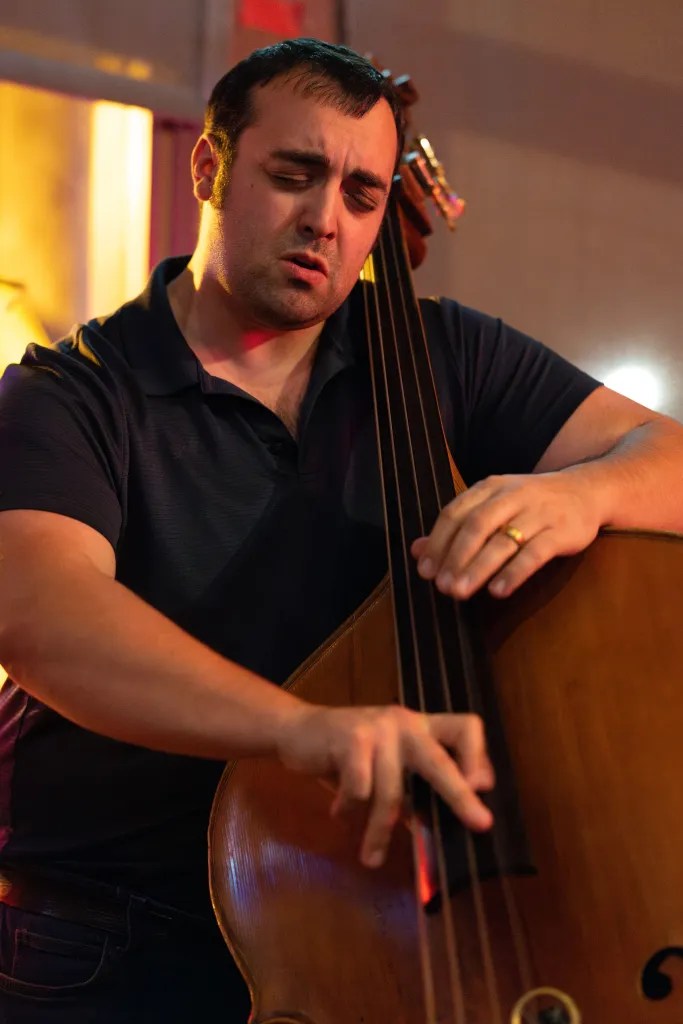

I would recommend the R5 II for event , wildlife, and portrait photographers. The only thing I would be cautious about is indoor sports photography with poor lighting conditions. If the electronic shutter is used for the up to 30 FPS speeds, there is a chance of banding. The mechanical shutter max’s out at 12 FPS, so sports users who need more than 12 FPS in poor artificial lighting may risk some banding issues.
Overall, the Canon R5 II proved to be an impressive upgrade, particularly excelling in low-light conditions with its new full-frame back-illuminated stacked CMOS 45MP sensor and advanced autofocus system. The camera’s ergonomics and user-friendly design, including the repositioned on/off button, enhance its usability for right-handed shooters. The R5 II stands out as a versatile and reliable choice for photographers seeking high performance in various shooting environments.
Wanna test out the R5II yourself?
Rent a R5II through Midwest Photo to see if this camera is the one for you! If you’re seriously considering purchasing ask about our try before you buy program as well. Making a camera purchase is a big deal so we want to ensure you are getting the right equipment for you!
Stop in the store or visit our rentals website to see available dates.
